Pages

Monday, August 31, 2020

Weather Forecaster Found Dead – Right After Sharing She Was Abused By Her High School Band Director


[ad_1]

A Texas weather forecaster was found dead over the weekend, hours after she revealed she had been groomed and abused in high school by a man twice her age.

Kelly Plasker of NBC affiliate KCBD NewsChannel 11 took to Facebook on Sunday to post a “final confession for the sins I am responsible for,” alleging that she had been manipulated into a relationship as a teenager by her high school band director.

Related: Priscilla Presley Breaks Silence On Grandson Benjamin Keough’s Suicide

Hours after the troubling post was shared, Plasker’s death was confirmed by colleagues at her station. A cause of death has yet to be revealed, but the news broadcast closed their tribute to the weather forecaster with a message about suicide prevention. Her colleague, anchor Kase Wilbanks, said during the tribute on Sunday night:

“Experts say stopping suicide means increasing the conversations about mental and emotional health. They say to reach out for help, so ask for help if you’re struggling or have had thoughts of suicide. Everyone should educate themselves on warning signs for those we love.”

So tragic…

In her final post, Kelly shared some of the darker moments of her adolescence that allegedly came at the hands of her band director. She wrote:

“I got thrown off course in high school by a man twice my age. My band director, using his time at Frenship high school to find his new ‘soul mate!’ He was supposed to be somebody looking out for me, but instead of looking out for me he looked at me in ways that men should not look at children. And I realize now that predators pick off easy prey. Particularly those without much family support or resources.”

Just sickening. She continued:

“The bad habits and games being in that 5 year long relationship can be called grooming and abusive at times call it total manipulation. I have unfortunately carried into relationships of mine that would’ve probably been beautiful had I not been convinced that I wasn’t worthy that I was never going to be good enough for anybody with which I can make memories and grow old together… He snuffed out my future and my ambitions in the most influential time of my life, my prime when I had so many doors and opportunities to explore but he was selfish convincing me that he didn’t want me to leave Lubbock Texas.”

Kelly explained that many more women had contacted her with similar stories, adding that she was “only now realizing how perversely pervasive, things situations which are still happening in our school systems MUST STOP!”

She concluded her message on a heartbreaking note, writing:

“Thanks all I needed to get out there as my final confession for the sins I am responsible for adding to the cross. I love you my friends. My brain is broken and I cannot take it anymore.”

This wouldn’t be Plasker’s first brush with suicide: her 19-year-old son Thomas took his own life two years ago. Just last month, the forecaster posted a tribute to him on Facebook, with the hashtags #SuicideSucks and #FlyHighTogether.

R.I.P. Kelly.

If you or someone you know is considering suicide, please contact the National Suicide Prevention Lifeline at 1-800-273-TALK (8255).

[Image via Kelly Plasker/Facebook]


Source link
[ad_2]

source https://earn8online.com/index.php/81691/weather-forecaster-found-dead-right-after-sharing-she-was-abused-by-her-high-school-band-director/

Black News Channel’s Kelly Wright interviews Trump


[ad_1]

The Black News Channel (BNC) is the nation’s only culturally specific news channel that reflects the diverse views of the Black community. Host Kelly Wright interviewed President Donald J. Trump on the Kelly Wright Show. This marks President Donald J. Trump’s very first on air interview with BNC.

In a surprise, President Donald Trump sat down with the Black News Channel to discuss a wide range of topics, including the 2020 election, COVID-19, and the failed stimulus negotiations.

The interview conducted by anchor Kelly Wright was a watershed moment for the network, which debuted in February after several delays. It came one day after presumptive Democratic Presidential Nominee Joe Biden made history by selecting Sen. Kamala Harris (D-Calif.), a Black woman, as his running mate.

It not only marked Trump’s first time on the network but also his initial interview with any African American-owned media. The National Newspaper Publishers Association (NNPA), the trade association of 230 Black-owned newspapers and media companies that comprise the Black Press of America, has repeatedly requested interviews with the president throughout his nearly four years in office.

White House and Republican National Committee officials have not acted on the multiple requests from the Black Press of America seeking access to the president, Vice President Mike Pence, and Education Secretary Betsy Devos.

Wright, a seasoned and Emmy-winning journalist who once worked at Fox News, asked the president about the economy, COVID-19, and school choice.

Trump, savvy with his words, claimed that “most states are doing well.”

“Now Florida is headed in a really good direction [with COVID-19], California and now Texas,” Trump said to Wright. “I see where Germany got a big surge, France and Spain. But we’ve done a very good job.”

Heavily criticized for calling the coronavirus the ‘Wuhan Virus,’ Trump repeatedly referred to China as the source of the pandemic. He said America’s economy, including in the African American community, was prospering before the pandemic, claims that don’t exactly match with various economists.

The president claimed that Biden and Harris would raise “everybody’s taxes and crash the [stock] market.” He referred to Biden as a “puppet,” and called the Green New Deal championed by former Democratic Presidential Candidate Bernie Sanders a “disaster” and a “cartoon joke.”

Wright asked Trump about underserved communities, particularly African Americans, and the president declared that he’d done much to improve the lot of all minorities.

“We’ve done Opportunity Zones, Criminal Justice Reform, and I saved HBCUs,” Trump said. “We gave them more money than they were seeking. Just before the virus came from China, the Black community had the best unemployment and employment numbers in history. They had a good month last month, they had the best numbers, and then we got hit with the China virus.”

Since the pandemic began in March, more than 50 million Americans have filed for unemployment compensation. The Republicans have sought to lower benefits for the unemployed, which has remained a sticking point in any potential bipartisan agreement to provide relief.

The president also reiterated his stand that all schools should reopen this fall for in-person learning despite more than 5.2 million Americans reporting having contracted the virus with at least 177,000 deaths.

When Wright asked Trump about his concern for children, the president demurred.

“They don’t get sick,” he said, despite numerous reported cases since some students returned to school.

“If you are elderly, have a bad heart or a problem with diabetes or something… Children don’t get it. The mortality rate is almost non-existent in young people,” Trump stated. “Their system is a little bit different.”

Wright also asked Trump about his decision to send federal agents into Portland and other cities where the president claimed that there “are some hard-core anarchists and agitators at the highest level.”

He claimed that police in places like Portland, Chicago, and New York aren’t allowed to do their jobs for fear of “…losing their jobs and pensions. A lot of them are leaving. Police have to be allowed to do their jobs,” he said.

Click here to view the full interview.

When asked how he plans to help heal the nation, Trump said success would accomplish that job. “We were there, and then China sent that virus,” Trump said. “I was starting to get along with Democrats that no one spoke to. We were there, and the jobs numbers for every community was doing great. But the plague came from China. Success will bring us together.

The Black News Channel (BNC) is the nation’s only culturally specific news channel that reflects the diverse views of the Black community. Host Kelly Wright interviewed President Donald J. Trump on the Kelly Wright Show. This marked President Donald J. Trump’s very first on air interview with BNC.


Source link
[ad_2]

source https://earn8online.com/index.php/81689/black-news-channels-kelly-wright-interviews-trump/

Overscheduled Child: Are Our Kids Too Busy?

[ad_1]

Today, structured activities and classes begin at younger and younger ages. Modern society sends the message that these activities help children’s physical and mental development. But an overscheduled child could actually be at a disadvantage compared to their peers who engage in more child-driven, free play during the early years. Read on to learn about the downsides of overscheduling, the benefits of free play, and how to foster a childhood full of free play.

A busy schedule for your child can get in the way of their ability to learn about the world—and themselves. Check out this article from Katie Melville to learn more about the downsides of overscheduling and the benefits of free play for your kids. #healthylifestyle #wellness

The Overscheduled Child

Parents sign up toddlers, preschoolers, and elementary-aged kids for multiple activities in the hopes of enriching their childhood and maybe even giving them a “head start” in life. These activities in and of themselves are not bad, but too many too soon can do more harm than good. Lots of lessons, practices, and games take away a child’s time to unwind, recharge, and just be a kid. The overscheduled child can suffer undesirable consequences.

Loss of Creativity

When children are shuffled from one activity to another, they lose some of the ability to create imaginative and engaging fun on their own. (1)

Less Time Outdoors

With more lessons and practices each week, gone are the days where neighborhood kids played outside and largely unsupervised. Less than one-third of mothers today report that their children play outside as much as they did themselves as children. (2) Half of all preschool children don’t spend any time outdoors on a daily basis! (3) Green spaces provide many benefits, and kids thrive outdoors where they can run free and explore in a less structured environment. (4)

More Screen Time

After school, lessons, and meals, what little time remains in a child’s day is often occupied by screen media. Despite guidelines urging parents to limit a child’s screen time, most children 8 and under are spending over two hours per day in front of a screen. (5) Excessive screen time is associated with behavioral issues, mental health issues, and less exercise, among other harms. (6, 7, 8)

Less Nutritious Food Choices

When you’re always on-the-go, home-cooked meals become the exception rather than the rule. Nourishing, family-centered dinners turn into granola bars and chicken nuggets wolfed down in the car on the way to practice. Even seemingly “healthier” fast food options, like salads from McDonald’s, don’t have much to brag about, with dressings full of industrial seed oils, added sugars, and a host of additives.

Burnout

Modern parents tend to worry about their kids being “ready” for the next step, whether for kindergarten or college. Instead of just letting kids enjoy being kids, parents spend their time “preparing” and pushing kids to their limits. Alvin Rosenfeld, MD, the author of The Over-Scheduled Child and former head of psychiatry at Stanford, says that young kids are pressured and pushed so much that “by the time they reach high school, they are bored and burned out.” (9)

Less Time for Free Play

This is obvious, but it’s probably the most important. When their time is overly occupied by structured activities, kids have less time to engage in free, child-driven play, which is absolutely critical to their cognitive, emotional, and social development. (10)

Increased Risk of Poor Health

Less play, less time outdoors, more screen time, unhealthy food choices, burnout—these side effects of overscheduling kids can contribute to negative health consequences, all of which are on the rise in youth and can lead to chronic disease in adulthood:

Free Play: The Antidote to Overscheduling

Busyness is not a badge of honor—especially not for our kids. If your five-year-old’s weekly calendar looks more like a CEO’s schedule than a kindergartener’s, it’s likely doing more harm than good. The antidote is simple: more free play, less packed schedules.

Play, at its surface, can appear frivolous and unproductive. But, on the contrary, free play is absolutely critical for a child’s proper cognitive, physical, emotional, and social development. (20, 21) When children engage in regular, creative, self-driven play, they become like scientists who learn about the world, themselves, and human relationships. (22) Play allows children to work through problems, try out new ideas, and explore their own physical and mental limits. Play is so important that the United Nations Commission for Human Rights has declared play to be the right of every child. (23)

Chris already published a great article outlining the numerous benefits of play through adulthood. Play in children boasts similar benefits crucial to a child’s growth and development: (24, 25, 26)

  • Healthy body, including flexibility, balance, strength, and endurance
  • Creativity
  • Cognitive development, including verbal skills, language comprehension, and concentration
  • Problem-solving skills
  • Emotional intelligence
  • Social skills and strong relationships
  • Cooperation
  • Confidence
Clearing out a packed schedule is a difficult task for most of us, but it is possible to adopt a freer, less busy lifestyle for yourself and your family. Behavior change is challenging, though, and many people find that they need support to successfully set screens aside or get outdoors more often—and that’s where health coaches come in.

Health coaching is all about behavior change; coaches support their clients, helping them to feel empowered enough to make big changes in their daily routines. Coaching is a vibrant, fulfilling career focused on making an impact on other people’s health and lives. If you’re interested in making a living while making a difference, a career as a coach could be the right fit for you. Click here to find out how to become a professional health coach.

How to Encourage More Free Play in Children

Despite what society says, young children do not need multiple structured activities and classes. In fact, David Elkind, PhD, author of The Hurried Child and child development expert, says that organized activities before age 6 or 7 are not even developmentally appropriate. Children are naturally curious and will discover their own interests as they climb, build, create, and pretend with others on their own terms.

The concept of increasing free play sounds simple, but the practice isn’t always easy.

Schools Can Add Fuel to the Fire

Schools can exacerbate the problem of overscheduled kids. Especially since the No Child Left Behind Act of 2001, schools have increased academics at the expense of arts, music, and free play. Across the United States, some 40 percent of elementary schools have limited or dropped recess. (27) This is detrimental to young children and can exacerbate behavioral issues like ADHD. The data suggest that kids who have more recess in school actually end up doing better academically in the long run. (28)

If you’re financially able to, there are some more “radical” options for schooling, including Montessori schools and nature-based education. However, those aren’t possible for many—most people send their kids to the local public schools. But the best you can do for your preschoolers and elementary-aged kids is to keep their non-school times less “busy” and more low-key with developmentally appropriate toys and supplies.

Fight the Pressure

Parents feel the weight of modern pressures to get their kids involved in sports at a young age and start academics earlier and earlier. Not giving in to this pressure can be the most difficult part of trying to “free” your kids from overscheduling. If you keep hearing from other parents how their first graders are in soccer and Girl Scouts and take piano lessons and dance lessons, it’s easy to wonder if your kid is missing out or falling behind.

Instead of trying to “keep up with the Joneses,” trust the childhood developmental experts. Surround yourself with like-minded families who place value on children’s free play.

Get Your Kids Outside

Unfortunately, not all children have the luxury of a safe, outdoor space to play. But access to nature is ideal for kids—get your kids outside whenever you can.

Kids thrive outside! Compared to indoors, when children are outside they are more likely to engage in free play and naturally increase their physical activity and gross motor activity levels. (29, 30) Green spaces are beneficial for everyone, kids included. Access to the outdoors correlates with better mental and physical health in children and is associated with improved symptoms of ADHD. (31)

Try to adopt the philosophy that “there is no bad weather, only bad clothing.” If it’s raining, let children jump in puddles in rain boots (or barefooted!). Buy wool socks and long underwear so that they can enjoy snowy, cold winters outside.

Less Is More

To encourage creative play, choose fewer passive toys and more simple, open-ended toys. Think blocks, books, pretend play items, and playdough versus toy phones and other devices that light up and play songs.

Electronic gadgets with bright colors look attractive, but when kids play with more traditional toys, they tend to engage in more varied and advanced language. (32, 33) Compared to watching Baby Einstein videos, preschoolers who play with blocks develop better language and cognitive skills. (34, 35)

Despite what our consumer-driven society says, young children really do not need many toys. And don’t be afraid to let your kids be “bored” sometimes. Boredom is where creativity is born.

Limit Screens

Discussing screen time limits for kids can cause a lot of tension in parenting circles, but the evidence is clear that screen media in young children is more harmful than helpful. (36) Because they compete with active playtime, screens may contribute to childhood obesity. Screen time is also associated with an increased risk of developing depression, anxiety, and trouble sleeping in children. (37, 38)

Free play provides numerous benefits to your children’s well-being. Limit structured activities and classes, especially in young children, to avoid overscheduling stress. Make sure your children have opportunities to explore the world and play on their own terms.


Source link
[ad_2]

source https://earn8online.com/index.php/81687/overscheduled-child-are-our-kids-too-busy/

Gravitas: Pakistan government targets WION's app


An official circular from the Pakistani government asks officers to uninstall the WION app from their phones. Palki S Upadhyay tells you why Islamabad is targeting WION. Install the WION app. Google Play store: https://bit.ly/2Oc1cA9 Apple App Store: https://apple.co/2RHfuuI About Channel: WION -The World is One News, examines global issues with in-depth analysis. We provide much more than the news of the day. Our aim to empower people to explore their world. With our Global headquarters in New Delhi, we bring you news on the hour, by the hour. We deliver information that is not biased. We are journalists who are neutral to the core and non-partisan when it comes to the politics of the world. People are tired of biased reportage and we stand for a globalised united world. So for us the World is truly One. Please keep discussions on this channel clean and respectful and refrain from using racist or sexist slurs as well as personal insults. Subscribe to our channel at https://goo.gl/JfY3NI Check out our website: http://www.wionews.com Connect with us on our social media handles: Facebook: https://ift.tt/2rnomdP Twitter: https://twitter.com/WIONews Follow us on Google News for latest updates WION: shorturl.at/fwKO0 Zee News English: shorturl.at/aJVY3 Zee News Hindi: shorturl.at/eorM1 Zee Business: shorturl.at/hpqX6 DNA News: shorturl.at/rBOY6 BGR: shorturl.at/eioqL .
source

source https://earn8online.com/index.php/81681/gravitas-pakistan-government-targets-wions-app/

Bachelor’s Vanessa Grimaldi Reflects on Nick Viall Relationship


[ad_1]

Feeling good. Vanessa Grimaldi looked back on her relationship with ex-fiancé Nick Viall after rewatching their season of The Bachelor.

“I really didn’t know what to post for tonight’s episode,” Grimaldi, 32, wrote via Instagram as she shared a selfie with her fiancé, Joshua Wolfe, on Monday, August 31, following season 21’s re-airing as a part of The Bachelor: The Greatest Seasons – Ever! special. “So many feelings have come through for me. But the big difference between how I am and feel now versus then, is the genuine feeling I have of being at peace.”

The Canada native explained that she was “the most insecure I have ever been” while filming the series, which originally aired in 2017. She noted that reading troll comments following the show’s end led to her question “my identity and my purpose.”

Vanessa Grimaldi Reflects of 'Bachelor' Relationship With Nick Viall
Nick Viall and Vanessa Grimaldi Phillippe Bosse/ABC

The special education teacher revealed that she “felt lost” after appearing on the reality show. “Add a new relationship into the mix, and everything felt impossible,” she wrote.

Three years after winning the final rose on The Bachelor — Viall proposed during the show’s 2017 finale — Grimaldi has gained perspective on the pair’s split. The two called it quits the same year and Grimaldi later revealed that she didn’t want Viall, 39, to propose on the show.

“One thing for sure is that @nickviall and I tried our hardest to make it work. And for that, I am grateful,” she continued. “3 years later, after A LOT of healing and self-growth, I truly am finally at peace. I’ve learned to laugh at the mean and hurtful comments and embrace the thoughtful and meaningful ones.”

Grimaldi added: “I know my purpose in this life is to help others. To do good. I know that I matter. I am finally back to feeling like Vanessa again and WOW does it feel good!!”

The Essential Oils founder, who announced her engagement to Wolfe in August, gave her love a shout-out before noting how grateful she is for the whole reality show experience.

View this post on Instagram

I really didn’t know what to post for tonight’s episode. So many feelings have come through for me. But the big difference between how I am and feel now versus then, is the genuine feeling I have of being at peace. ⁣ Back when we were filming and after the show ended, I was the most insecure I have ever been. I felt small and insignificant. I would read all the troll comments and ignore the beautiful and thoughtful messages that were coming my way. I questioned my identity and my purpose. I felt lost.⁣ ⁣ Add a new relationship into the mix, and everything felt impossible. One thing for sure is that @nickviall and I tried our hardest to make it work. And for that, I am grateful!⁣ ⁣ 3 years later, after A LOT of healing and self-growth, I truly am finally at peace. I’ve learned to laugh at the mean and hurtful comments and embrace the thoughtful and meaningful ones. I know my purpose in this life is to help others. To do good. I know that I matter. I am finally back to feeling like Vanessa again and WOW does it feel good!! And the best part is that I have the love of my life @jbrwolfe by my side 💘⁣ ⁣ Friends, things can feel difficult and unfair at times but it means change is coming. If I hadn’t gone on @bachelorabc gone through a public breakup, have people send me hurtful comments and messages, I wouldn’t be the person I am today: resilient. In the end, it will always make sense. Always.⁣ #thebachelor #goat

A post shared by Vanessa Grimaldi | MTL (@vanessagrimaldi30) on

“Friends, things can feel difficult and unfair at times but it means change is coming,” she concluded. “If I hadn’t gone on @bachelorabc gone through a public breakup, have people send me hurtful comments and messages, I wouldn’t be the person I am today: resilient. In the end, it will always make sense. Always. #thebachelor #goat.”

Earlier this month, Grimaldi and Viall reunited for the first time since their breakup when she joined him on his “Viall Files” podcast. While the episode hasn’t been released yet, the Wisconsin native has expressed happiness for his ex now that she’s found love.

“Well, thank god I followed you back a week ago to hear this news,” Viall commented on Grimaldi’s Instagram post about her engagement. “Congrats to you two! Lucky guy. ”

Listen to Here For the Right Reasons to get inside scoop about the Bachelor franchise and exclusive interviews from contestants!

Source link
[ad_2]

source https://earn8online.com/index.php/81664/bachelors-vanessa-grimaldi-reflects-on-nick-viall-relationship/

Two strangers, with the same first name, and a terrifying story about ketamine in policing


[ad_1]

They nudged him awake and the conversation was calm for the first several minutes. Deputies told him they were just checking to see if he was all right. But the encounter ended with McKnight on life support after being injected with a high dose of a drug called ketamine.

"I was out cold for three days on life support," he said. "My family didn't know where I was."

When McKnight finally woke up in an Aurora hospital, he couldn't believe what he was seeing on the news. His eyes widened when he saw a story about another young black man named Elijah. Elijah McClain was in a coma and near death after a police encounter that also involved a ketamine injection -- the same drug McKnight had been given before everything went dark. The two incidents happened just 10 miles apart and within days of each other, but involved different law enforcement and EMT agencies.

"I'm thankful to be alive," McKnight said. But he is convinced the use of ketamine in police calls is being abused when there is no medical need for it.

"They are being lazy. I guess they didn't want to deal with a drunk asshole," he said.

McKnight is not alone in questioning whether police are influencing paramedics to use the powerful tranquilizer that requires hospitalization for nonmedical reasons.

CNN has found ongoing investigations in multiple states regarding emergency responders' use of the fast-acting drug to tranquilize people against their will. In some places, such as Colorado and Minneapolis, the use of the drug by paramedics rose sharply in recent years.

Outrage over its use has motivated a city council member in Aurora, Colorado, to propose a temporary ban on the administration of the drug by first responders. In Minneapolis, the police department decided to create a new policy for its officers in 2018.

Sidewalk to ICU

Body camera video shows Arapahoe County sheriff's deputies approaching Elijah McKnight in 2019 to check on his welfare while he's passed out on the sidewalk. The conversation is calm and cordial to start, even after McKnight admits unprompted that he has warrants out for his arrest.

Deputies and McKnight go back and forth with McKnight asking them to call his father and deputies taking down his dad's number. But, eventually, the officers move to detain McKnight and he tries to run.

The video shows officers grabbing him and pulling him down in a struggle. He's accused of kicking one of the officers in the face. McKnight denies that, but admits he was angry, scared and uncooperative.

The deputies warned him and then use a Taser on him. McKnight is lying face down in the dirt with his hands cuffed behind his back as the two deputies lean on his legs. He screams that his legs are in pain. So when paramedics arrive, he is relieved.

"When they first came on the scene, I was like, please help me," McKnight told CNN. "Finally, I have witnesses, now the police can't do something to me."

Body cameras captured the encounter between McKnight and first responders.

The paramedics assess him. McKnight loudly asks to be lifted up.

Still on the ground, McKnight occasionally yells out but is able to give correct answers when asked what year it is and who is the president.

"You're a little too hyped up right now, you gotta relax," a medic from South Metro Fire Rescue says.

"I am being cooperative," McKnight insists.

"You are. You are. And I appreciate it, man," the paramedic says.

After about six minutes, paramedics determine McKnight does not need hospital treatment.

But then one of the deputies asks, "You can't give him anything can you? Unless you go to the hospital, right?"

A paramedic responds, "We can give him ketamine. He'll be sleeping like a baby, but he'll have to go to the hospital."

McKnight objects, yelling: "Don't give me. Don't inject anything into my veins."

It is unclear whether a paramedic or deputy responds, saying, "Just give it to him. I mean he's bucking the three of us. Just give it to him."

And they do. After a 500-milligram shot, the paramedics' post-incident report says McKnight is being "wildly combative." On body camera video, they say he is still able to "lift" them.

The video shows McKnight cuffed and laying still, yelling out now and then. Paramedics call a physician and get permission to inject him with 250 more milligrams of ketamine -- a total dose higher than the drug manufacturer and the state health department recommends for a man of his weight. And finally, McKnight passes out. On the paramedic logs, it says McKnight was suffering from "excited delirium," a controversial medical diagnosis.

McKnight sees that as simply an excuse to knock him out because police didn't want to deal with him. Once ketamine is given, the recipient has to be hospitalized.

"They said I didn't need to be hospitalized. So they definitely wasn't going to give me ketamine until the police asked for it," McKnight said. "I definitely wasn't experiencing excited delirium, I can tell you that."

A powerful drug

Ketamine is often the strongest sedative in a paramedic's kit in departments that allow its use. In Colorado, where McKnight lives, the crews need a waiver from the health department to use it. Doctors administer it for pain relief and it can even be a general anesthetic.

In Colorado in the spring of 2013, the state health department's Emergency Medical Practice Advisory Council cleared the use of ketamine in the field to treat patients with "a presumptive diagnosis of excited delirium," but EMS agencies need a waiver to use it.

Excited delirium is defined as a condition where a person is so violently agitated that they can essentially exercise themselves to death, two doctors told CNN.

Colorado health officials said of their 2013 ketamine waiver decision: "The intent was to protect both patients and providers from the harm that can come from patients experiencing extreme agitation."

This month, the state health department announced plans to review its ketamine waiver program.

Between 2018 and 2019, there was a 72% increase in ketamine waivers for excited delirium Issued by the Colorado Department of Public Health and Environment. Some 902 waivers were made from 2018 to June 2020, even though the department guidance says the condition is rare and ketamine should "not be considered the standard of care for the management of excited delirium or agitation."

That increase in usage is "alarming," said Dr. Mary Dale Peterson, president of the American Society of Anesthesiologists. "It can be fatal, as we have seen in a couple of cases without proper monitoring and attention to detail."

The American Society of Anesthesiologists said it was so concerned with its use that it put out a statement this year on the use of the drug by first responders.

"Ketamine, or any other drug, you know, should not be given for purely law enforcement purposes. We give drugs to treat medical problems," Peterson said.

The syndrome of "excited delirium" is not recognized by major medical organizations such as the American Medical Association, the American Psychiatric Association or the World Health Organization. It is, however, recognized by smaller organizations that deal with emergency medicine, such as the American College of Emergency Physicians.

An article in the Journal of Emergency Medical Services said the use of ketamine to deal with excited delirium in the field could "ensure the safety of" first responders and patients.
While another article in the Western Journal of Emergency Medicine says ketamine may be safely and effectively used by trained paramedics following a specific protocol, more study is needed to identify the best medication for agitated patients before they get to the hospital.

Dr. Walter Dunn, a psychiatrist and UCLA associate clinical professor, says the controversy over "excited delirium" doesn't mean the syndrome does not exist -- but it is tricky to diagnose.

"Even clinicians would have a difficult time diagnosing an excited delirium," he said. "When you employ ketamine you better be darn sure that this is excited delirium and not something else."

That is because, aside from being a powerful sedative, when coupled with other medications or substances, the drug can have unintended consequences, Dr. Peterson says.

Excited delirium is what authorities from two different EMT agencies said McKnight and McClain, who had no alcohol in his system, were experiencing when they were injected. Both received doses larger than the state medical guidelines for their size.

The Colorado health department recently determined medics' actions on McKnight were "independent of police requests" and "warranted."

His encounter with police ended with him being loaded on to a gurney to be taken to a hospital, where he was hooked up to a ventilator to keep him alive.

Peterson, the anesthesiologist, said that was a known side effect of the tranquilizer. "Depending on what study you look at, 30% to 57% of patients will require intubation," she said.

That's also what happened to McClain. But he never woke up.

McClain's fatal encounter

Four days after McKnight was taken to hospital, McClain, 23, was walking home from the store at 10:30 pm on August 24, 2019.

A resident called Aurora police, saying McClain seemed suspicious because he was moving his hands around and wearing a ski mask in the summer. McClain's family says he had a blood condition that would make him feel cold.

Elijah McClain died days after his encounter with police.

As police approached, the violin player and masseur was listening to music through headphones. When an officer touched him, he appears startled.

"Please respect the boundaries that I am speaking," McClain says on body camera video.

Everything happens so fast. There is a struggle when officers decide to arrest him. The slight, 140-pound McClain is cuffed and on his stomach. He says he can't breathe. Two officers are on him. He is put in a chokehold at least once. He vomits. At one point, an officer says, "Whatever he's on, he has incredible strength ... yeah, crazy strength."

It turns out he was not "on" any illegal drugs. According to the autopsy, none were found in his system.

Paramedics are on the scene by now; they administer 500 milligrams of ketamine, nearly twice the recommended dose.

"I've been in practice 30 years and never given a dose that high," Dr. Peterson said. She is not involved in McClain's case.

Mari Newman, an attorney for the McClain family, told CNN: "'Incredible strength' is the buzz word police use. It's an excuse that the person they are dealing with has superhuman strength. They get paramedics to use ketamine to cut corners and quickly sedate people they don't want to deal with."

McClain ends up having a heart attack in the ambulance on the way to the hospital. He was intubated and put on a ventilator. He died three days after his encounter with police and paramedics.

New investigations have been opened into the circumstance surrounding McClain's death.
His family is suing the city of Aurora and several of the police officers and paramedics.

"He could not breathe. He was fighting for his life," said his father, LaWayne Mosley. "I wish I was there to fight for him."

The autopsy report said McClain died of "undetermined causes" but contributing factors were "intense physical exertion and a narrow coronary artery." The coroner said an "unexpected reaction" to a therapeutic level of ketamine "cannot be excluded" as a factor in his death.

Aurora Fire Rescue determined last November that their paramedics' actions were "consistent and aligned with our established protocol" and that McClain was showing signs of "excited delirium, a dangerous and often inexplicable condition."

The district attorney's office declined to press charges against the officers involved and they were later reinstated after being put on routine administrative leave.

Nearly a year after his death, the city, state and health department opened new investigations into his case.

Elijah McClain's case gained attention again this summer when protesters demanded action.

The FBI and the Justice Department have been reviewing the case since 2019.

A spokesperson for the National Fraternal Order of Police said the idea that police are using excited delirium as an excuse to use excessive force by injecting ketamine on any subject is out of line.

"I push back on that," Sherri Rowan, the national director for wellness services for the National Fraternal Order of Police, told CNN. "As soon as they respond and recognize what it is, medical personnel are summoned. EMTs and paramedics are called because of the risk that is possible when someone is recognized to be having that sort of condition. Police departments are looking to do the best job that they can."

A paramedic's story

There is no national database that tracks ketamine use by EMS workers across the US. CNN found several ongoing investigations into the use of ketamine by first responders across the country.

One completed investigation was in Minneapolis. Ketamine is also used by first responders in nearby communities, such as Woodbury, where Joseph Baker used to be a paramedic.

"I have been pressured by police to administer ketamine," Baker told CNN, in his first media interview. In August, he filed suit against the city of Woodbury, where he worked until 2019.

Joseph Baker says he was pressured to use ketamine by police when he was a paramedic in Minnesota.

Baker says he had to quit after suffering retaliation and being disciplined for exposing falsified EMS training attendance documents that allowed people to get or keep their certifications to be paramedics, and disciplinary action for refusing to bow to police pressure to use ketamine when he thought it was not medically necessary.

The fight over ketamine was one of the final straws, he said. In 2019, he says he was called to assist with someone having a mental health crisis. Before he even arrived, dispatch was telling him and his crew to "get the ketamine ready," he said.

"I was met by multiple officers who asked, 'Do you have your ketamine ready, do you have it drawn up?' And I said, 'No. I have it available, but I'd like to evaluate this patient,'" Baker told CNN.

That angered the police officers, he said. But, in the end, he said, talking to the patient worked and no drugs were required.

"The most powerful medication that we have on the ambulance is our ability to speak with patients. Ketamine takes that away." Baker said. "I don't believe it should be requested by police. I don't tell them when to use their mace. They should not tell me to administer drugs."

In a statement to CNN, the city of Woodbury said it "internally reviewed its Emergency Medical Services training records and protocols and determined the training and protocols were in compliance with all licensing requirements. Contrary to the allegations in the Complaint, no training records were falsified, and Mr. Baker's complaints were properly addressed."

It said with regard to the administration of any medications such as ketamine: "No employee of the City of Woodbury improperly administered any such medications."

The city added, "Mr. Baker was never disciplined or subject to retaliation and we categorically deny the allegations in the complaint."

Baker's attorney, Kenneth Udoibok, disputes that and says not a month goes by at his small Minneapolis office without a call linked to administration of ketamine.

"People are not complaining that the paramedic injected them with ketamine. They are complaining that a police officer caused that to happen," Udoibok told CNN.

Care or improper conduct?

A report by the Minneapolis Office of Police Conduct Review showed the appearance of ketamine in police reports increased from two cases in 2010 to 62 in 2017 -- a 3,000% increase. Between 2016 and 2018, "analysts observed 8 cases where MPD [Minneapolis Police Department] officers participated in the decision to administer ketamine."

That report also found in some cases, the person being detained was not only handcuffed, but strapped down on a stretcher in an ambulance before receiving ketamine.

Ryan Patrick, an attorney on the Minneapolis Office of Police Conduct Review, said during a public city council meeting that the full picture was complex.

"There is a wide range of involvement in those cases," he said, "ranging from officers directly suggesting that ketamine in particular be administered to EMS professionals asking MPD officers if they believe they should be sedated."

Attorney Udoibok calls ketamine use "the perfect crime against citizens."

"If police are accused of abusing the use of ketamine, the police say it wasn't their decision to administer it, that was the paramedics' choice," he said. "And paramedics are never going to admit they are liable, so they will say ketamine was necessary."

After the report was made public, Minneapolis police instituted a new policy telling its officers the decision to administer sedatives "must be clearly made by EMS personnel, not MPD officers."

Due to the McClain case, an Aurora City Council member is pushing for a temporary ban on the use of ketamine by first responders until the investigations in his case are complete.

McClain family attorney Newman said it should not have been used in the first place against Elijah.

"This is just another way to use excessive force against people, especially people of color."

McKnight said he hopes they ban it all together.

"I woke up choking on a ventilator. This should not happen to anyone else ever again."

CNN's Josh Campbell contributed to this story.


Source link
[ad_2]

source https://earn8online.com/index.php/81663/two-strangers-with-the-same-first-name-and-a-terrifying-story-about-ketamine-in-policing/

Impact of the Immune System on the Brain and Mental Health

[ad_1]
Most are aware that neurons send neurotransmitter signals to each other in circuits within the brain. My new book, The Secret Language of Cells, shows that similar conversations occur among all the cells in the body and these wide ranging conversations determine all physiological functions. While there are numerous examples of this cellular communication in the book — such as capillary cells sending directional signals for white blood cells to find an infection and capillaries instructing stem cells how to produce particular cells for the brain, this article will focus on a few ways that cellular conversations among immune cells and brain cells affect mental health. 

Two-way cellular conversations between traveling immune cells and stationary brain cells use signals that are sent as molecules, or molecules inside sacs, that are secreted into tissues, blood vessels, and cerebrospinal fluid. The signals can profoundly affect general cognition and memory, and are highly related to depression and pain, as well as responses to stress. 

For many of the major influences on the brain, signals are sent by T cells that travel in the cerebrospinal fluid (CSF). These T cell signals are relayed to specific regions of the brain by special lining cells of the chamber that holds the CSF. T cell signals sent in the CSF to brain cells can have an impact on many aspects of cognition and behavior. For example, when we are ill with a fever, T cells send signals for the brain to create the “sick feeling” so we will slow down and take care of ourselves. When the infection is over, T cells send a different type of signal, using pulses of secreted molecules, that tells the brain to restart and maintain normal cognition. 

In adults, a small number of new neurons are regularly produced in the memory center of the hippocampus. These new neurons are vital for producing new memories. Research has shown that depression correlates with a decreased production of these neurons, which can lead to the decrease in memory often seen in depression. But it was not clear how this happened. It is now known that signals from T cells can alter the production of new brain cells and therefore increase or decrease memory ability. During depression, T cells signal for fewer new brain cells to be made, which leads to reduced memory. These signals also affect the generalized inflammation throughout the body that often occurs with depression. When the depression is treated by medications, ECT, psychotherapy, etc., the immune signals begin to again stimulate the increased production of new neurons, better memory, and decreased inflammation. Better understanding these signals could lead to entirely new treatments for depression. 

Stress is another situation that involves signaling between the immune system and the brain. While short term stress can be helpful by triggering increased learning and a rise in the production of neurons in the memory centers, long term stress does the opposite and can produce damaging inflammation and decreased memory. Both brain cells and immune cells pick up perceptions of stress. In a mechanism similar to that of depression, T cells send signals during long term stress that produce inflammation and decrease the production of new neurons for memory.  

As immune cells travel throughout the body, they have many opportunities to send signals back and forth with neurons and other supportive brain cells. For example, a T cell—the master immune regulator—can secrete molecular signals directly into tissue that then travel to nerves. When the signal is picked up by the neuron, it can be relayed throughout brain circuits, which can then affect various other organs. This leads to a mechanism whereby an acupuncture needle or electrical stimulus triggers a local T cell—for example, in the wrist tissue, nearby but not in a blood vessel or nerve. When triggered by the acupuncture stimuli, the T cell sends a signal into the tissue that travels to a neuron that is not far away, which then relays another signal through brain circuits causing the acupuncture effect in a distant area of the body.

All of the effects on the brain and mental health described above occur because of elaborate back and forth communication between T cells and the brain. In my book, The Secret Language of Cells, there are detailed explanations of the wide range of conversations that various bodily cells engage in with brain cells. There is a discussion of the multiple types of signals that occur between neurons and the three types of supportive brain cells (astrocytes, microglia, and oligodendrocytes). Another research area described in the book is related to chronic pain. New findings show that chronic pain syndromes are correlated with very large, multi-faceted synapses and circuits, involving many more connections that ever seen before. Conversations in these complex multi-cell synapses and circuits involve a wide range of cells including neurons, the three supportive brain cells, immune cells, and even organ lining cells and microbes. Based on the discovery of these new types of synapses and signals, entirely new avenues for treatment will be developed for pain, depression, and damaging stress. 

Related Articles


Source link
[ad_2]

source https://earn8online.com/index.php/81661/impact-of-the-immune-system-on-the-brain-and-mental-health/

A Look at Some of Kate’s One-Hit Wonders and UFO Dress Identified


[ad_1]
Hello, and welcome to a new post!  Way back when the lockdown started, I asked what sort of things you would like to see covered on the site during the absence of ‘normal engagements,’ and one popular topic was pieces worn by the Duchess that we have only seen one time. 

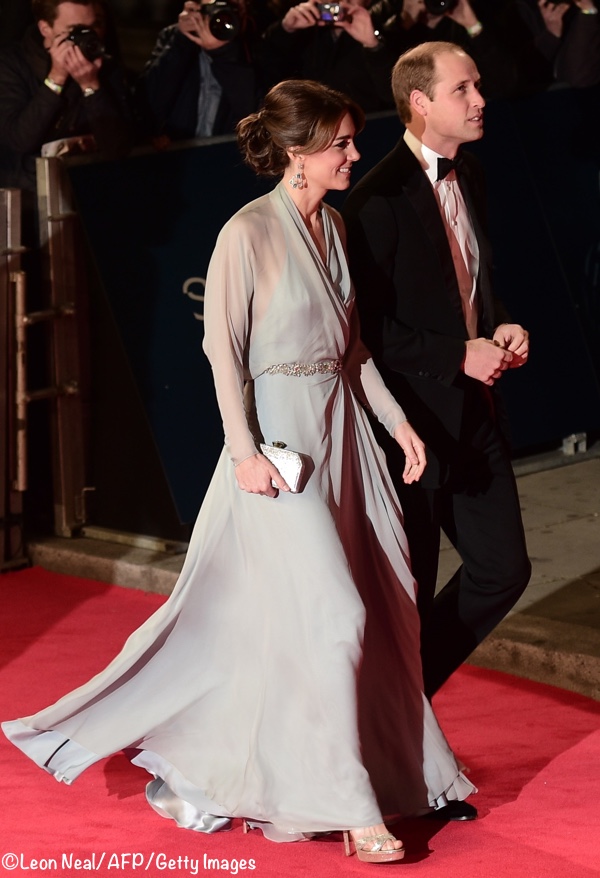
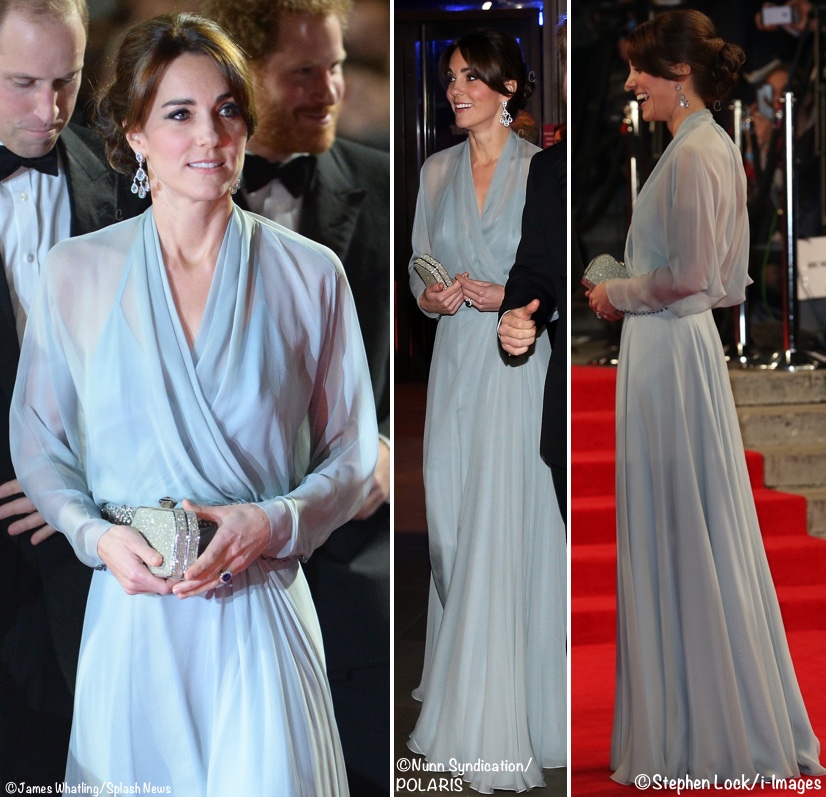
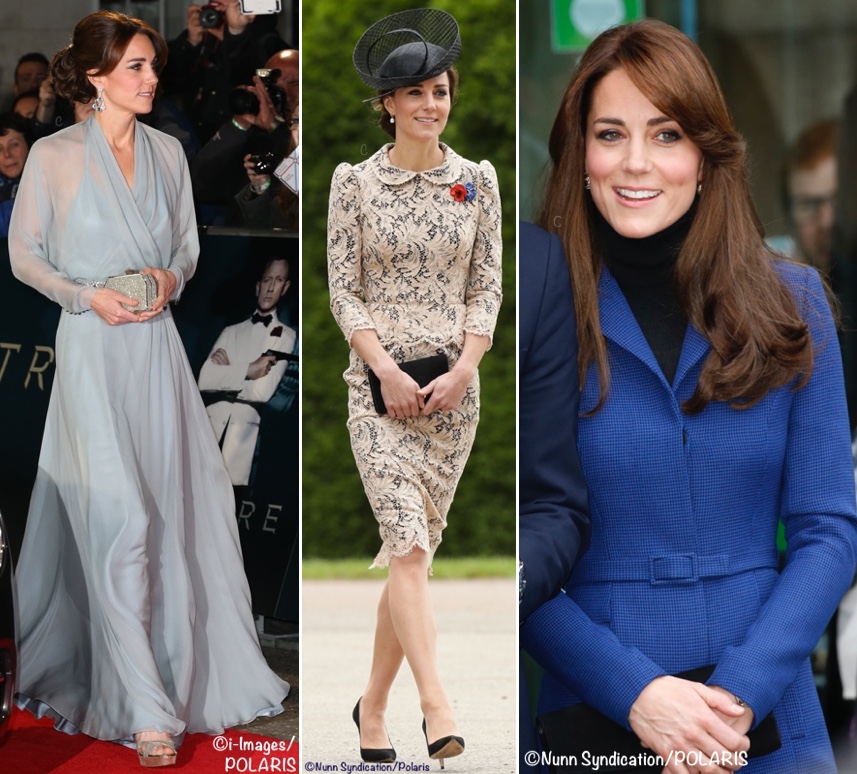
We’ll begin with a gown worn for the October 2015 London premiere of SPECTRE

The Duchess was in a Jenny Packham design for the glittering event. 

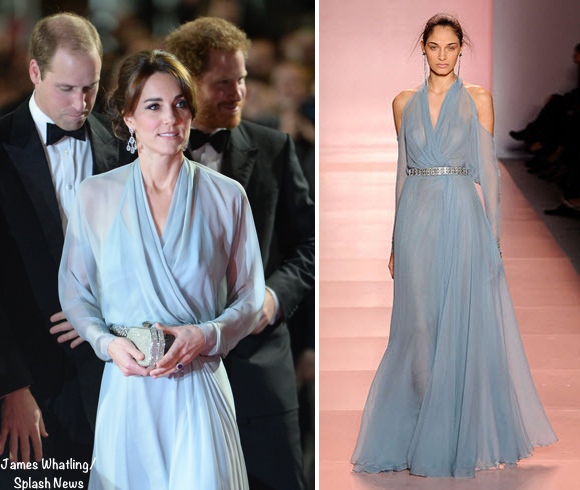
Kate’s gown was based on a dress from the Spring 2011 collection. 

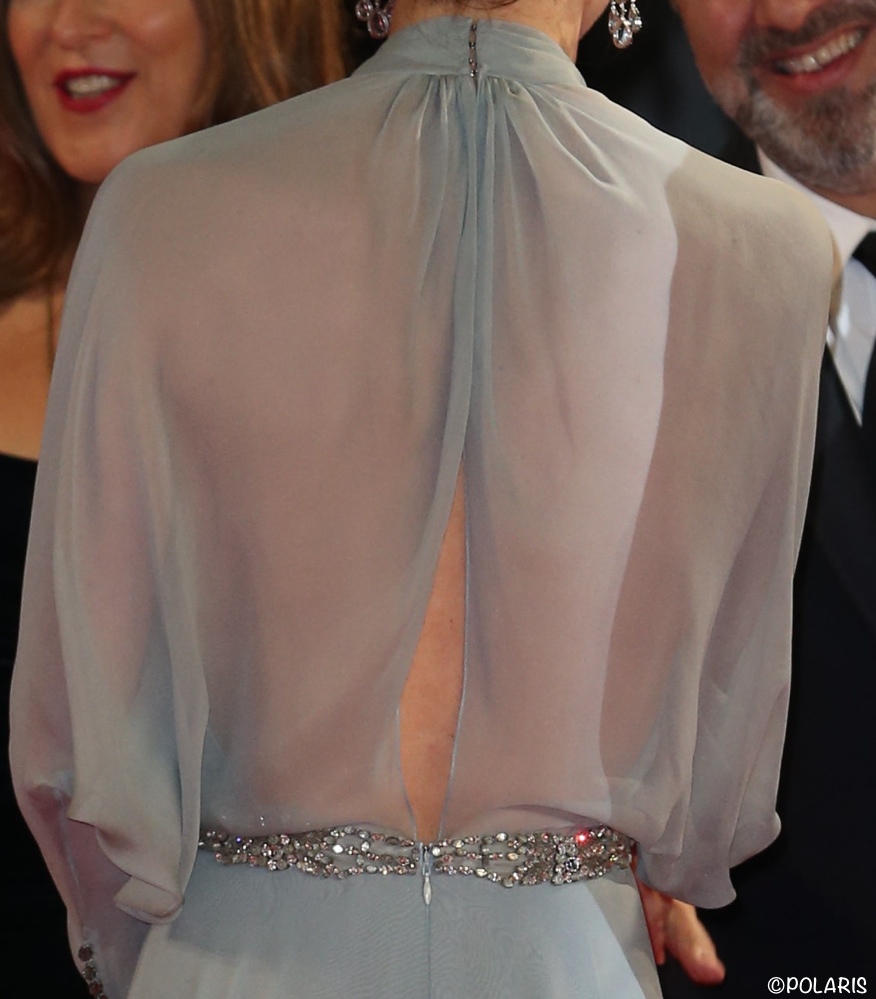
The gown showcased a crossover top in the front and a full, flowing, multi-layer skirt. Beneath a sheer overlay the dress had a halter-style top. The bodice back was slit open, and the dress closed at the back neck and with a zipper in the skirt portion of the piece. A shimmering rhinestone belt accented the waist and the skirt was full. 

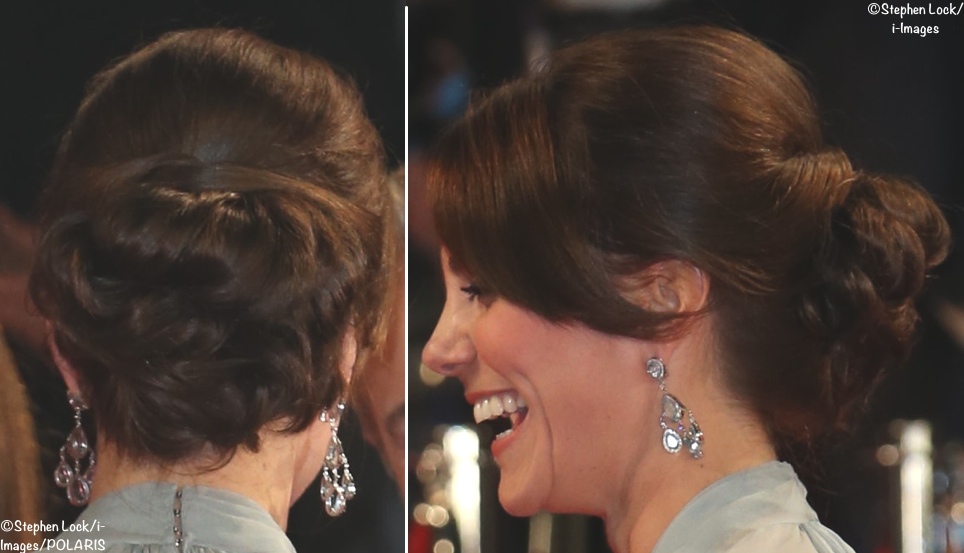
There was also an extended row of rhinestone or crystal button/snaps at the wrist. Kate wore her hair up.

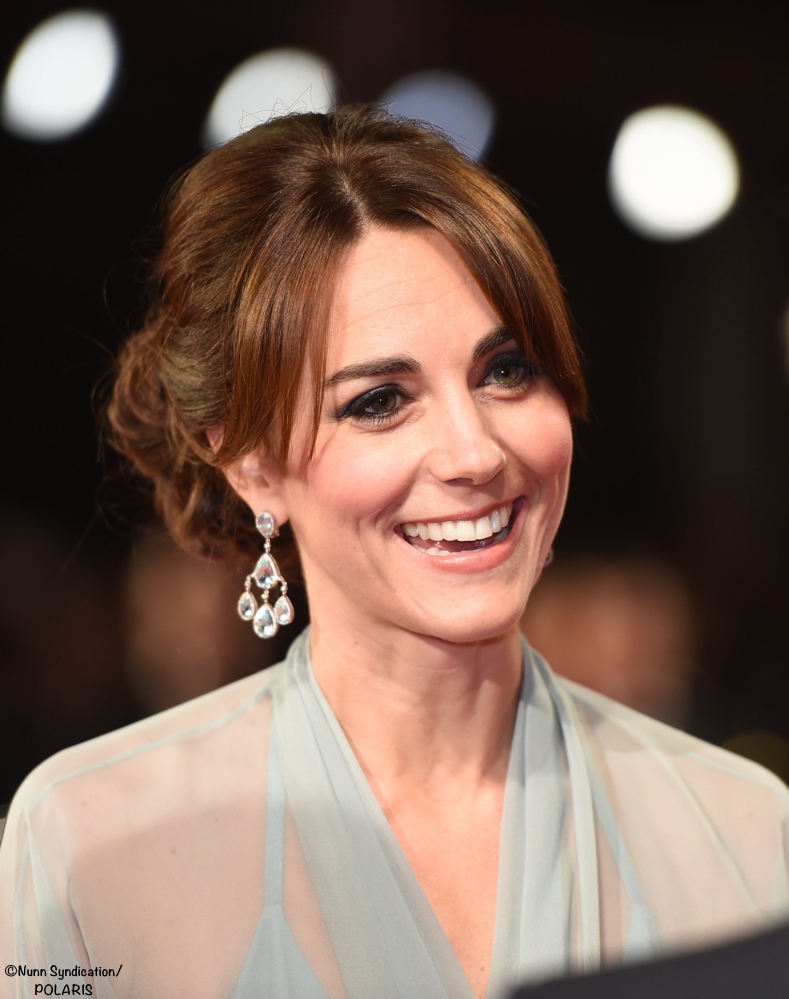
This allowed an unobstructed view of her Robinson Pelham earrings, the jeweler’s Pagoda style set with blue topaz and diamonds in white gold.

The Duchess’s mother, Carole Middleton, wore these earrings to Kate and William’s evening wedding reception in 2011.

Here is a better look at the Duchess’s updo. 

She accessorized with a miniature version of Jenny Packham’s Casa handbag, a box clutch that featured angular enamel and a crystal-encrusted clasp. Kate also brought back her ‘Vamp’ platform sandals from Jimmy Choo.

And another look.

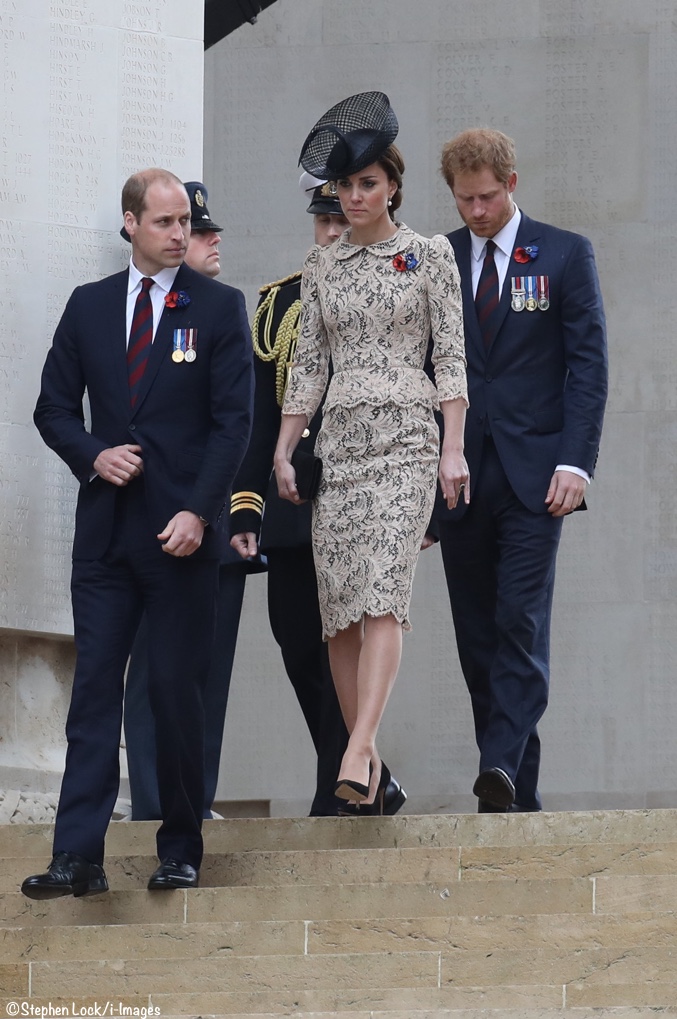
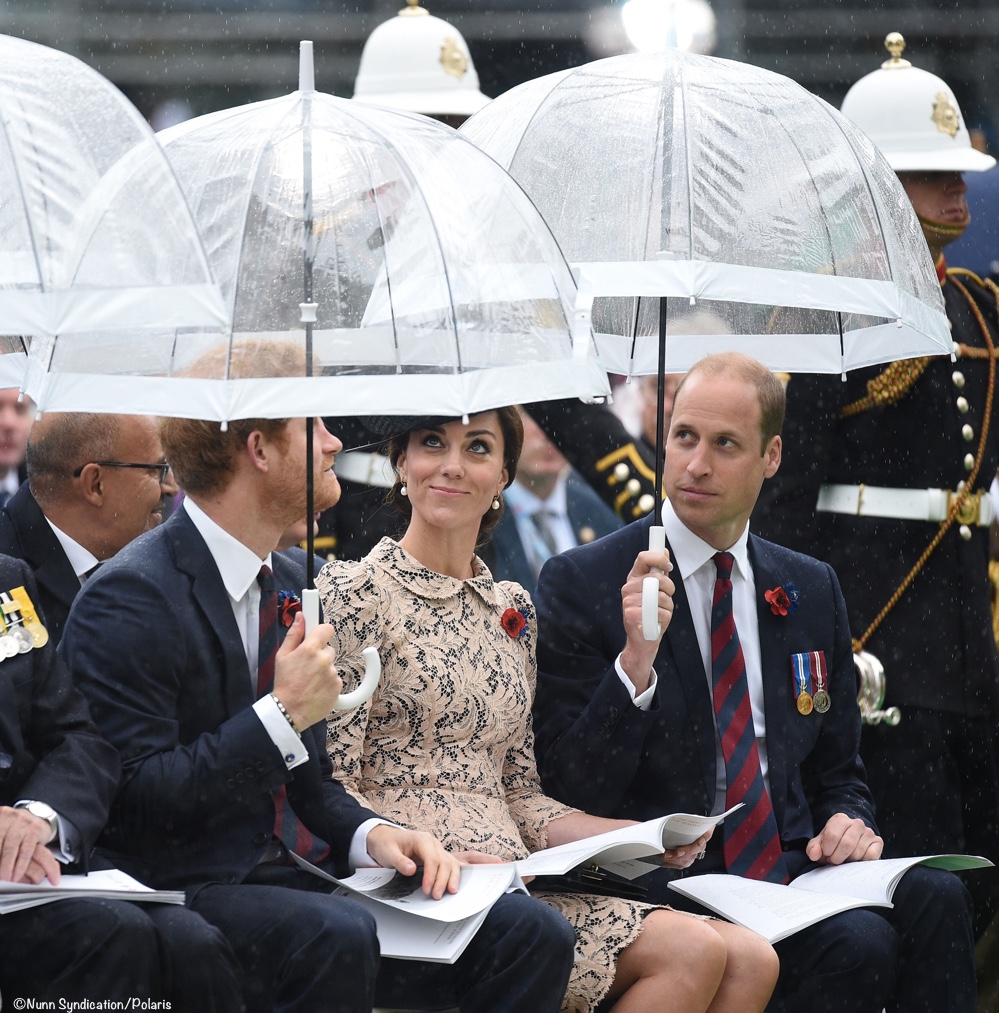
Our next look is from a far more somber occasion, ceremonies in France marking the 100th anniversary of the Battle of the Somme.

There were horrific casualties on both sides, and the battle went on for months, with more than one million men killed or wounded.

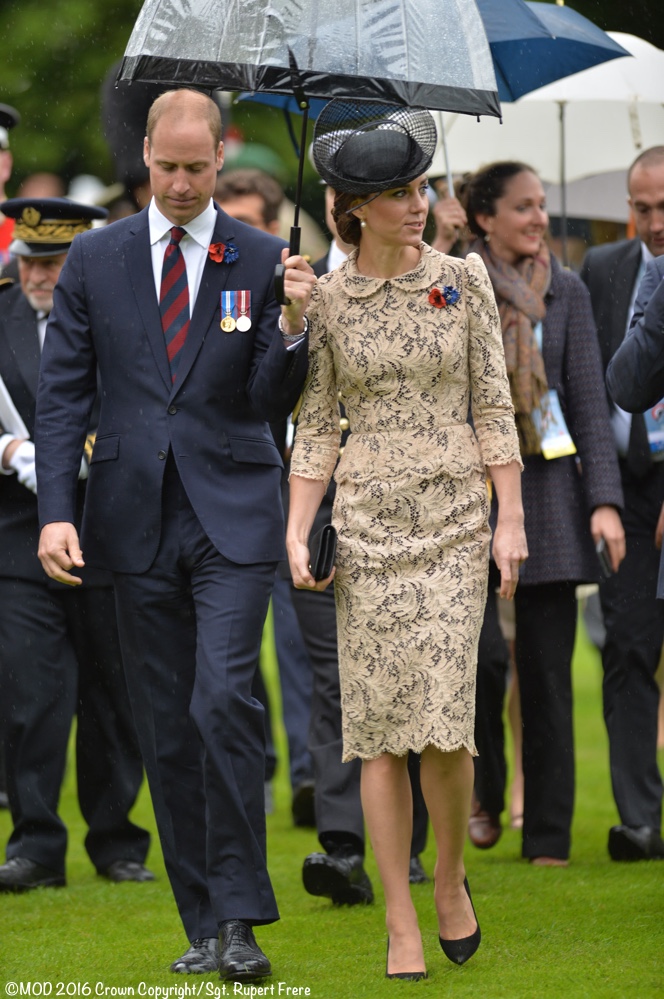
Rain fell on and off throughout the ceremony.

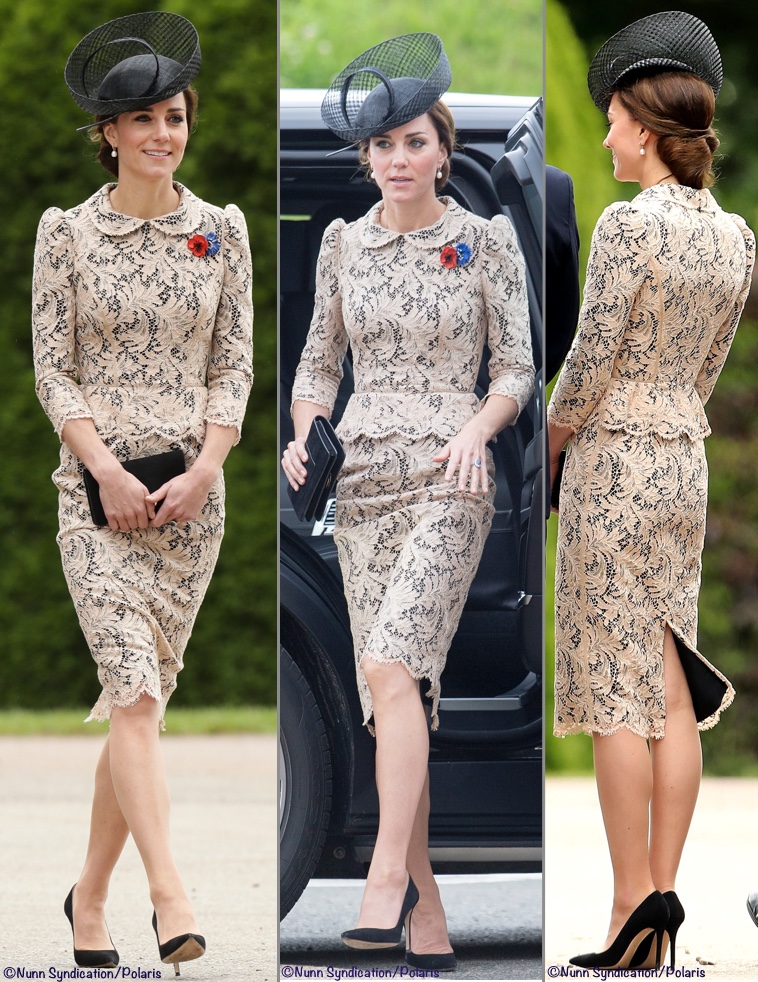
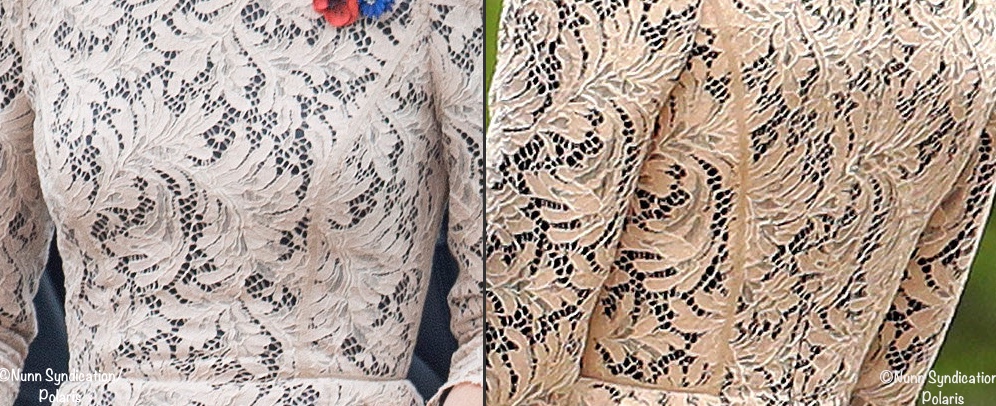
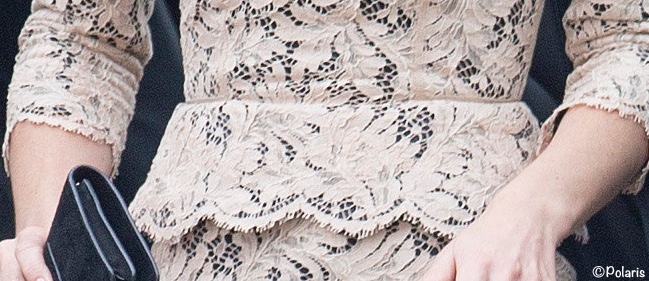
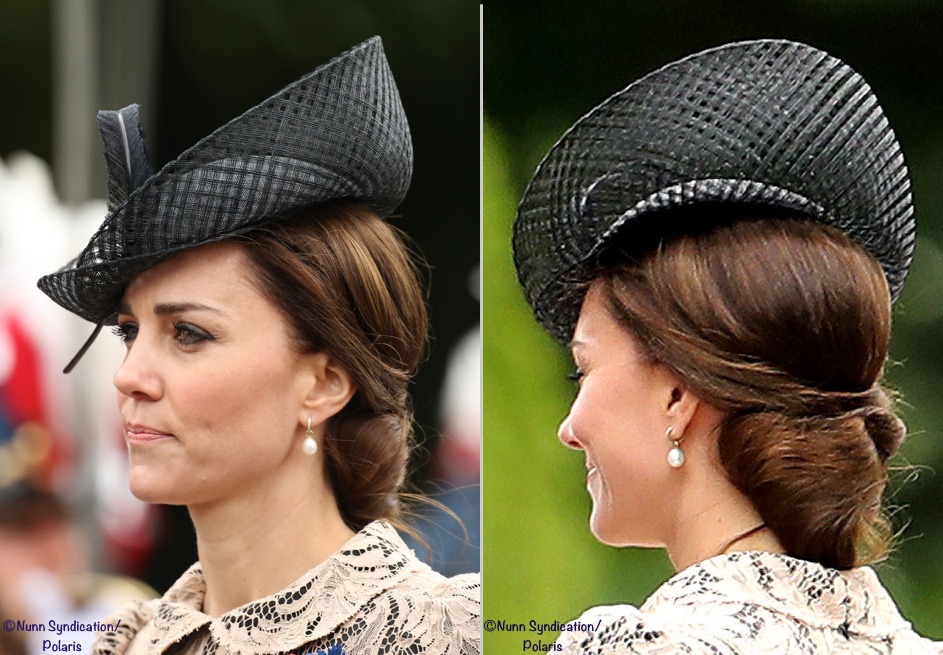
The Duchess chose a cream and black lace dress by Jenny Packham for the occasion. The sheath featured a Peter Pan collar, princess seaming, peplum waist, three-quarter length sleeves, and a back vent on the skirt.

A closer look at the elegant lace and seam details. 

The lace is by Sophie Hallette, the renowned French textile house that also made lace used for Kate’s wedding gown and shoes.  Below, a closer look at the delicate eyelash lace at the sleeves and peplum.

The Duchess brought back a Sylvia Fletcher for Lock and Company hat.©Nunn Syndication/Polaris

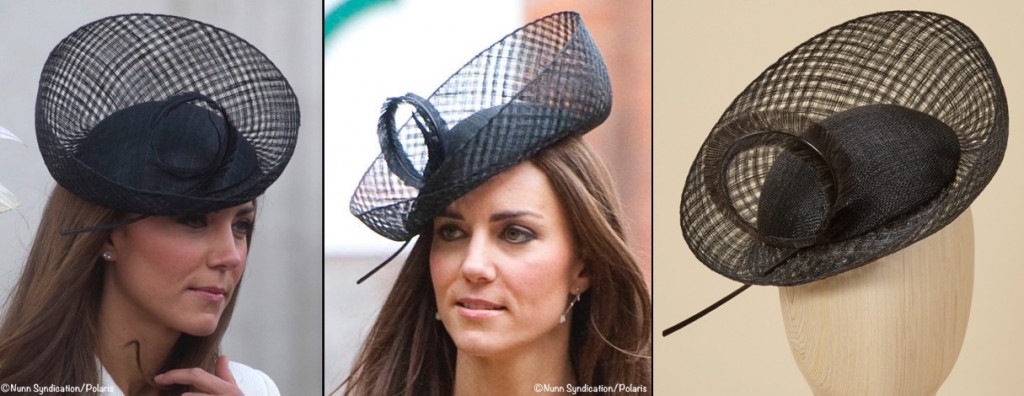
It was the Lion Tamer Perching style. 

Designed by our resident milliner Sylvia Fletcher, the Lion Tamer is a signature style in our Couture collection. Hand-sculpted from layers of dyed ebony sinamay and finished with a simple ostrich feather, it elegantly frames the face.

The Duchess first wore the chapeau for Trooping the Colour in 2011 (below left), as well as a wedding in June of 2011 (below center).

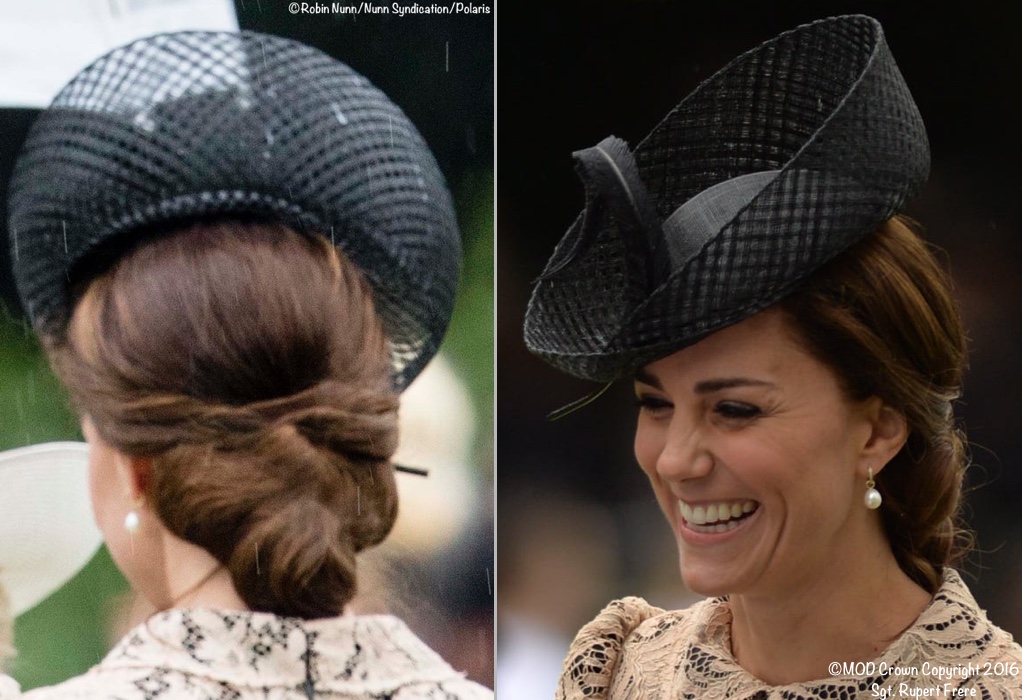
This offers a look at Kate’s updo, seen during the ceremony, and in a lighter moment when speaking with children earlier in the day.

Kate also wore a poppy, as well as a ‘bleuet’ cornflower, the latter a symbol of remembrance in France.

She carried her Mulberry’ Bayswater’ clutch and wore her Gianvito Rossi Signature pumps. 

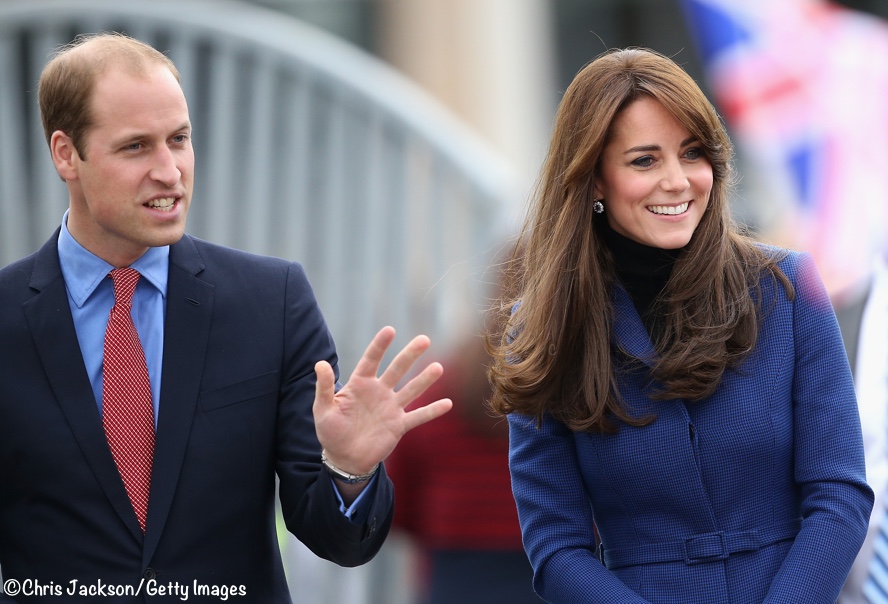
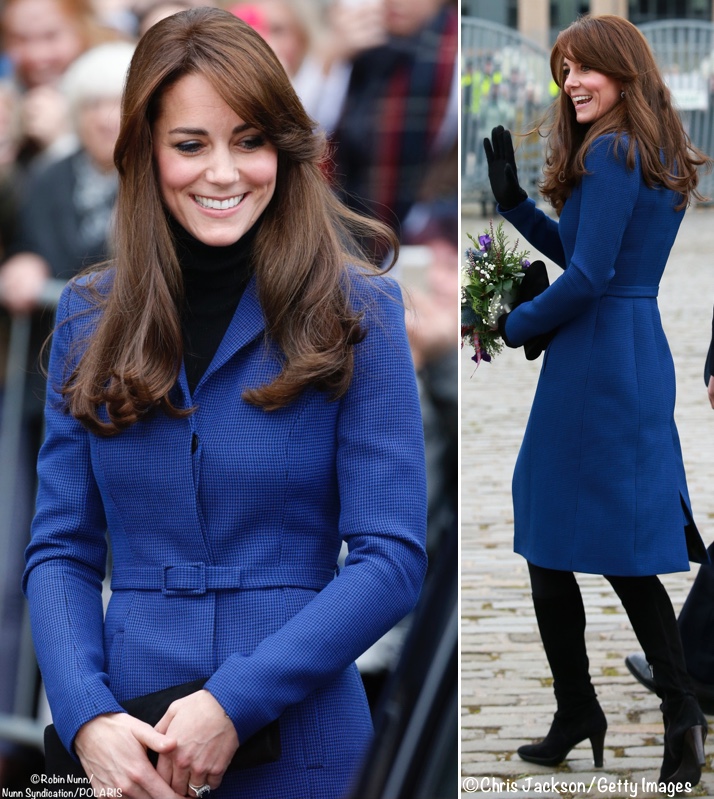
Our third one-hit-wonder is from a visit to Dundee, Scotland, in October 2015. 

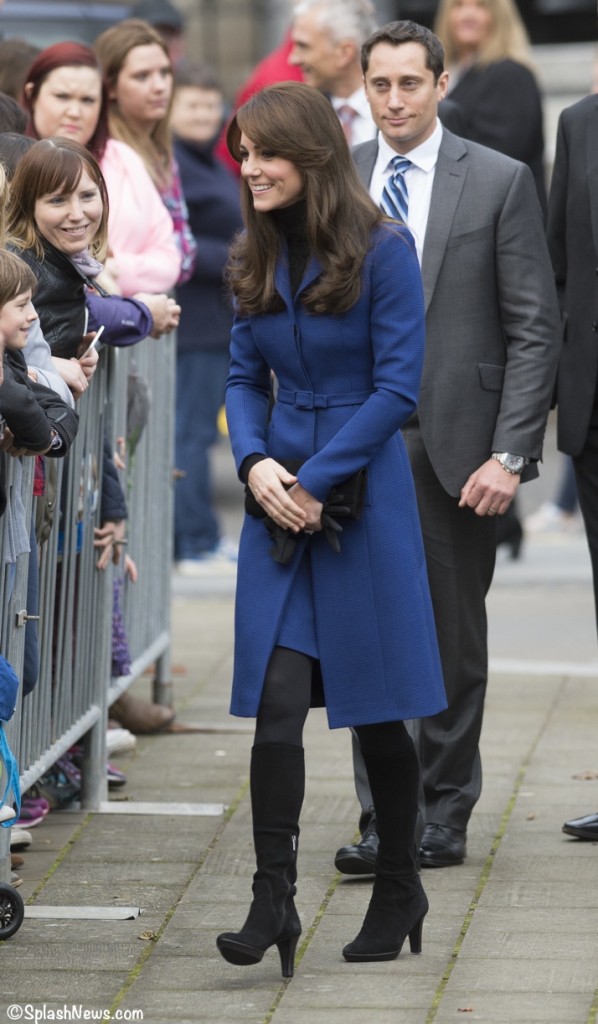
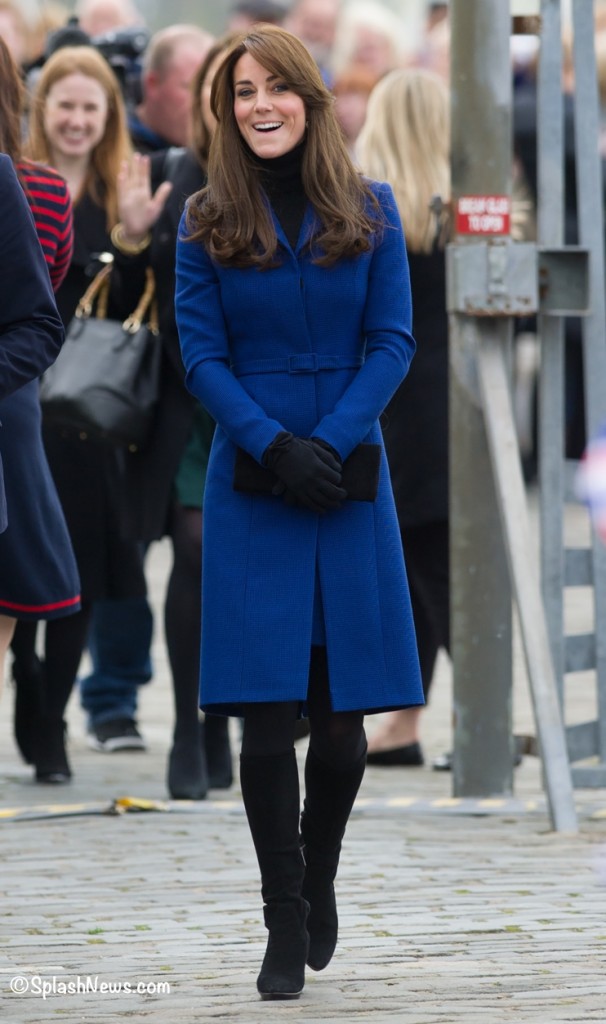
The Countess of Strathearn, as she is titled in Scotland, wore a bespoke ensemble by Scottish-born designer Christopher Kane.

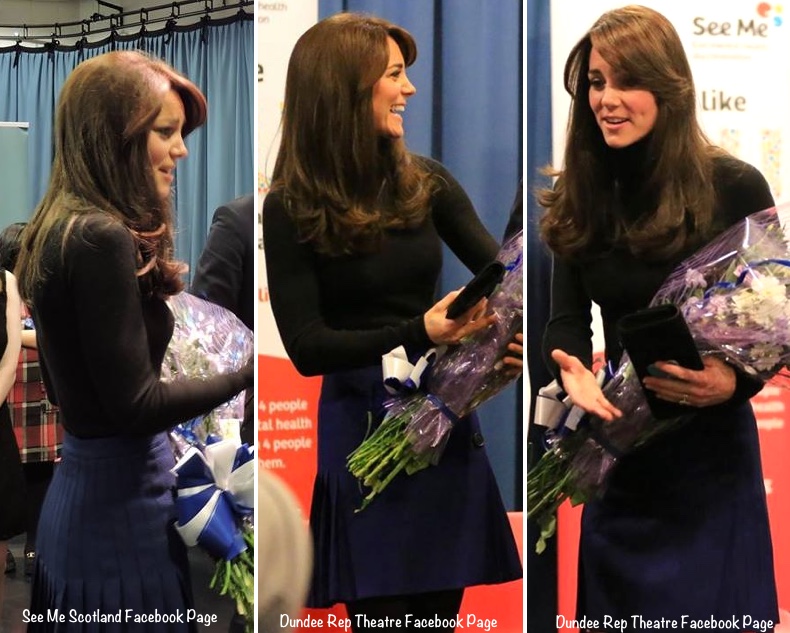
The look included a coat and skirt by the designer and a black turtleneck sweater. 

Here you get a look at the kilt. 

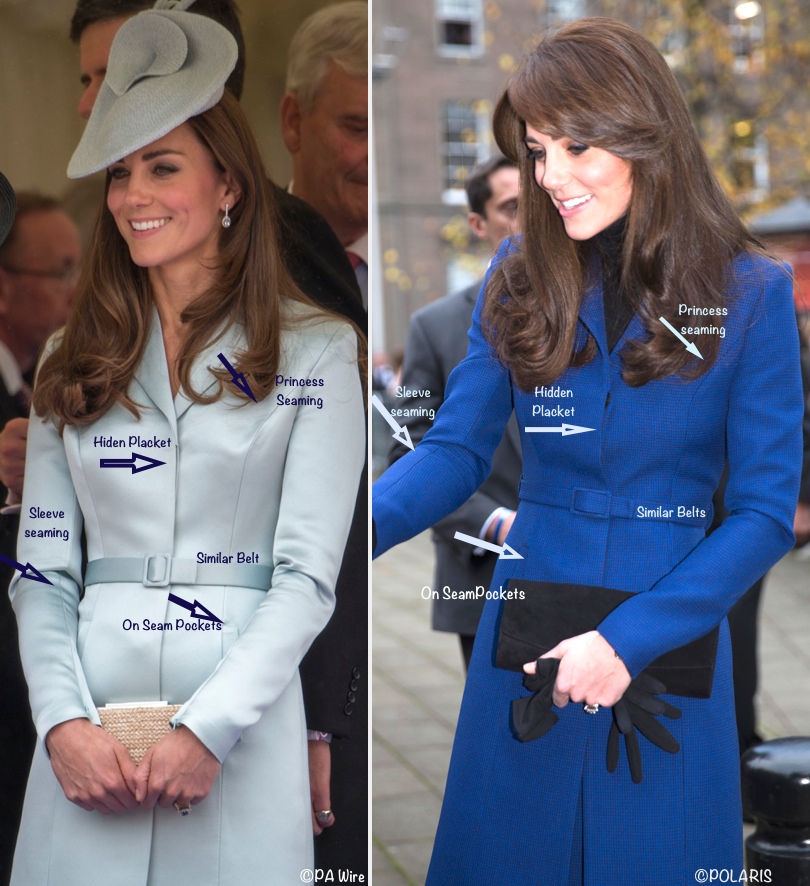
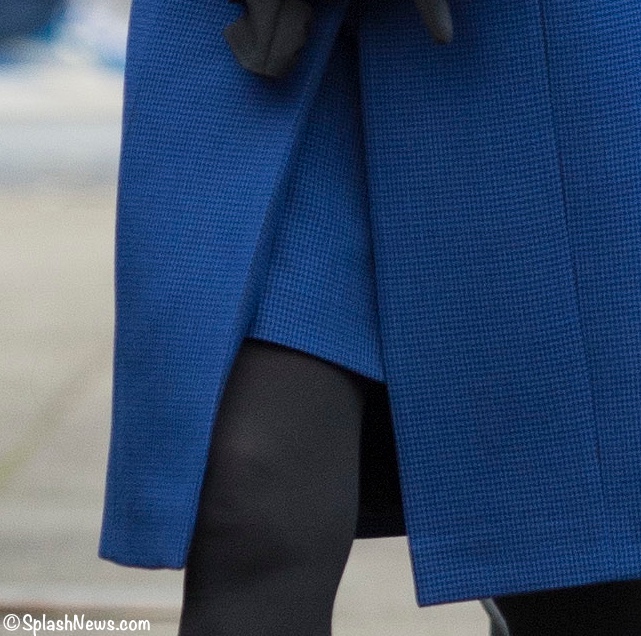
The coat was described as a “slim-fitted dogtooth wool tailored coat with belt,” and it was almost identical to the icy blue satin coat by Christopher Kane the Duchess wore to the Olympic Games opening ceremony in 2012 and Order of the Garter in 2014.

This graphic points out many of the similar design elements. The silhouette is much the same; other shared elements include princess seaming, the hidden/covered placket, small lapels, on-seam pockets, and slim self-belt.

Two more views of the coat, an excellent piece of tailoring.

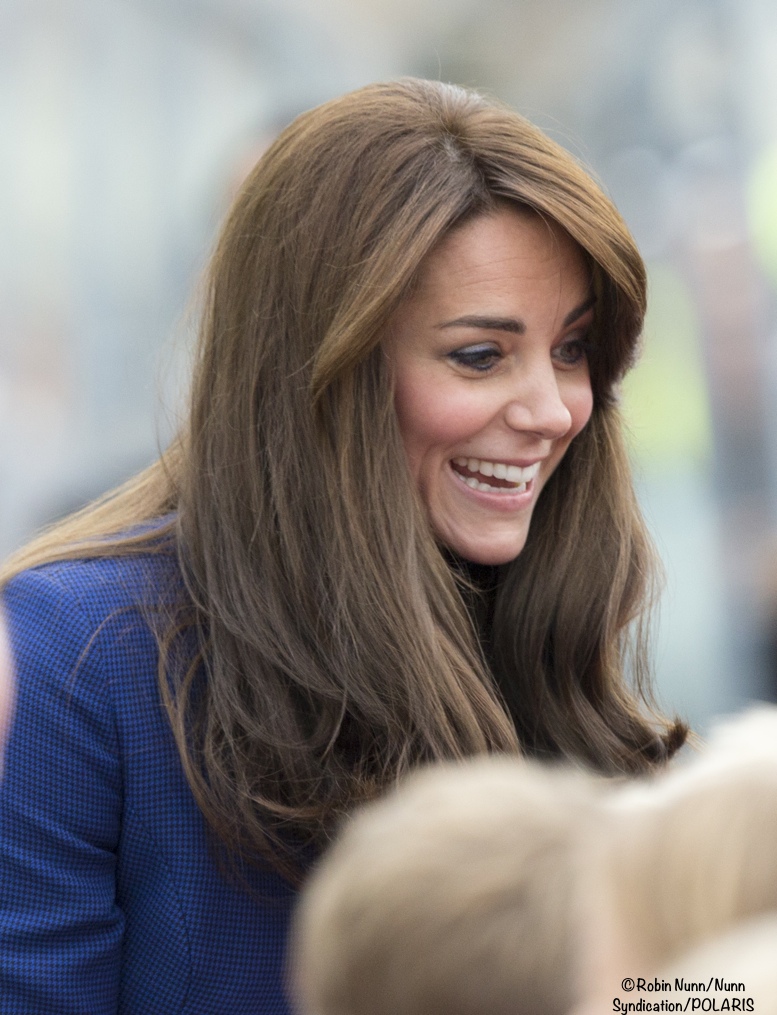
This offers a good look at the fabric used in the pieces, a royal blue houndstooth (also called dogtooth, primarily when used in a smaller pattern) in royal blue.

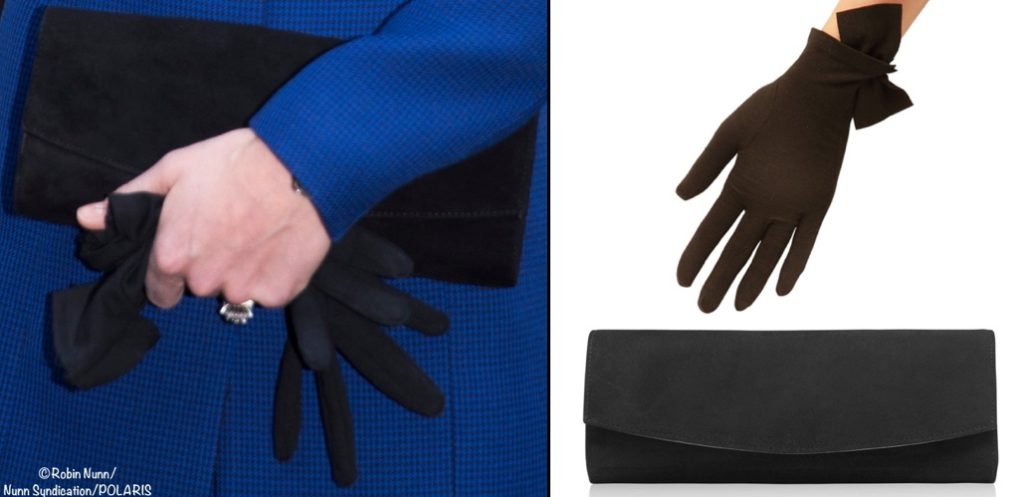
Kate accessorized with her Cornelia James ‘Imogen’ gloves and her ‘Muse’ clutch by Stuart Weitzman.

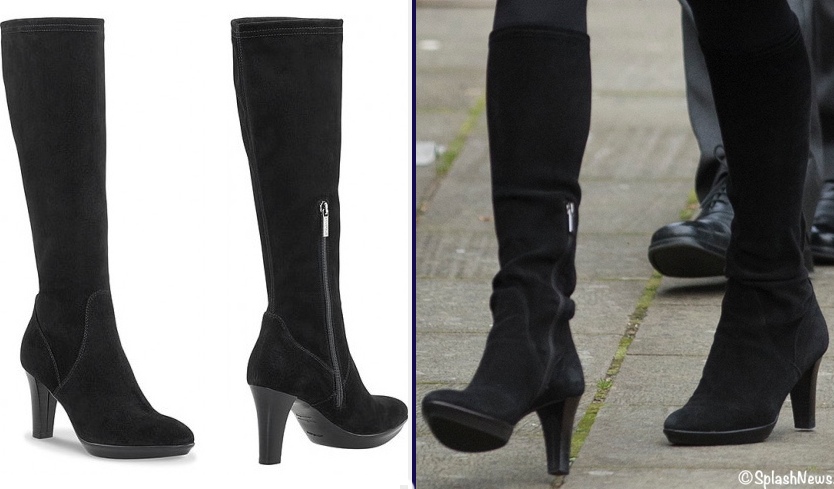
For footwear, the Duchess chose her Rhumba boots by Aquatalia. 

We’ll close this section of the post with one more Dundee photo. 

Three different ensembles for three very different functions. Do you have a favorite? 

In suggesting content for our lockdown posts, a few asked that I cover some of my favorite Kate looks. You are looking at one of my Top Ten, the Christopher Kane worn in Dundee.  I thought the color was particularly flattering on Kate, and the coat’s crisp tailoring paired with the kicky skirt was a win, particularly with the nod to Scotland through the traditional kilt design and the choice of a Scottish-born designer. 

I have quite a list going of pieces that qualify as one-hit wonders, but I would love to hear more from you on looks the Duchess has worn that you think should be included in future posts!   

++++++++++++++++++++++++++++++++++++++++

Our other topic is an update on what was a UFO piece worn by the Duchess on a June video call. 

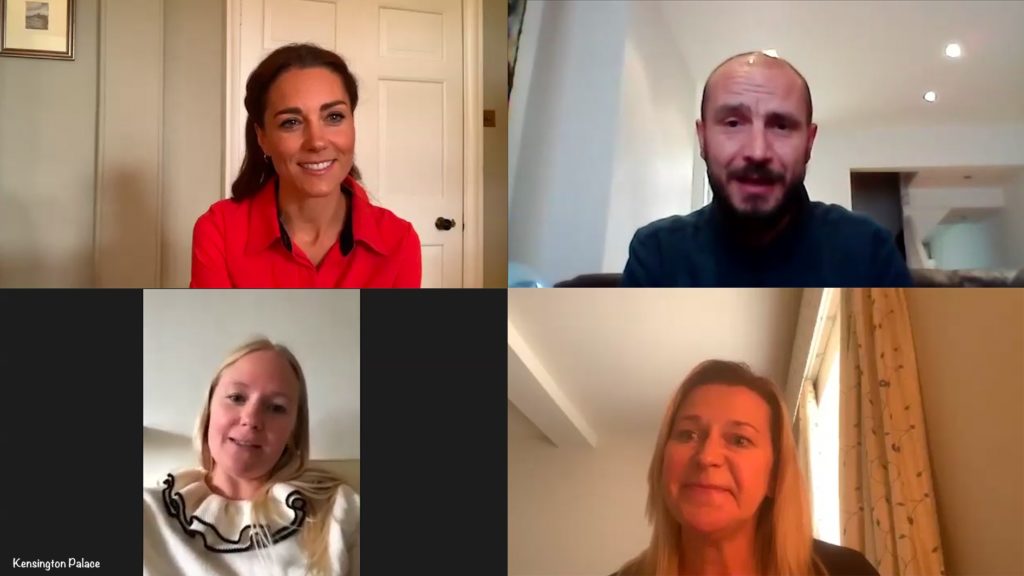
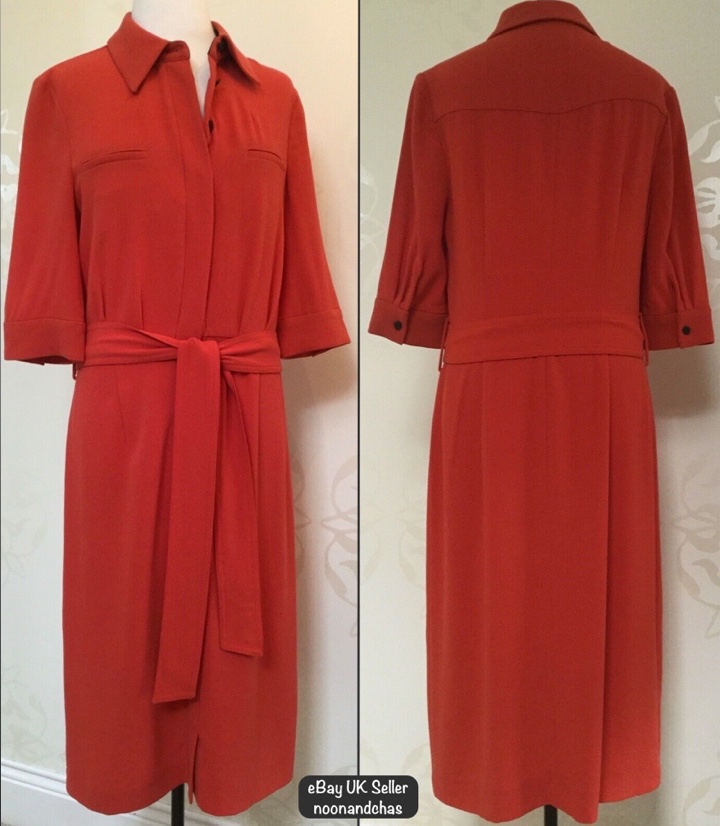
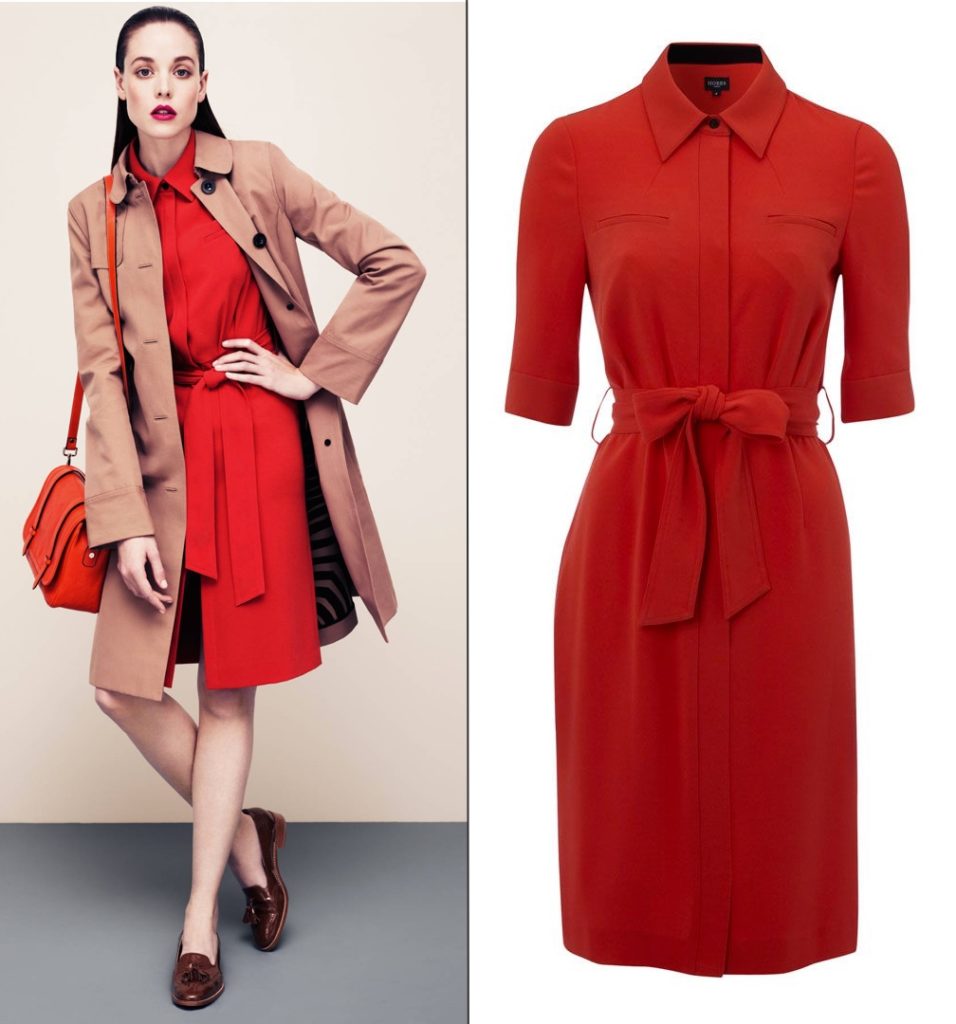
On the call, the Duchess made a ‘virtual visit’ to Clouds House, an Action on Addiction treatment center.  After hours (and hours!) of searching, I wasn’t able to figure out what Kate wore, nor were other royal fashion writers. But this weekend, I received a message from ID whiz and longtime friend Stephanie Champion-Helton (aka Lady Coventry on Twitter), who told me that eBay UK Seller noonandchas had solved the puzzle: this was a dress by Hobbs London.  Behold, the ‘Loreley Dress’ from the retailer’s s/s 2012 collection.Hobbs Loreley dress what Kate wore burnt Jasper spring summer 2012 Duchess of Cambridge

The striking color is called ‘Deep Jasper,’ likely referencing the jasper stone. The piece has a shirt dress silhouette in a fabric that is a 78% acetate, 22% polyester blend, per eBay UK Seller noonandchas. These next photos are via the noonandchas auction listing for the dress.

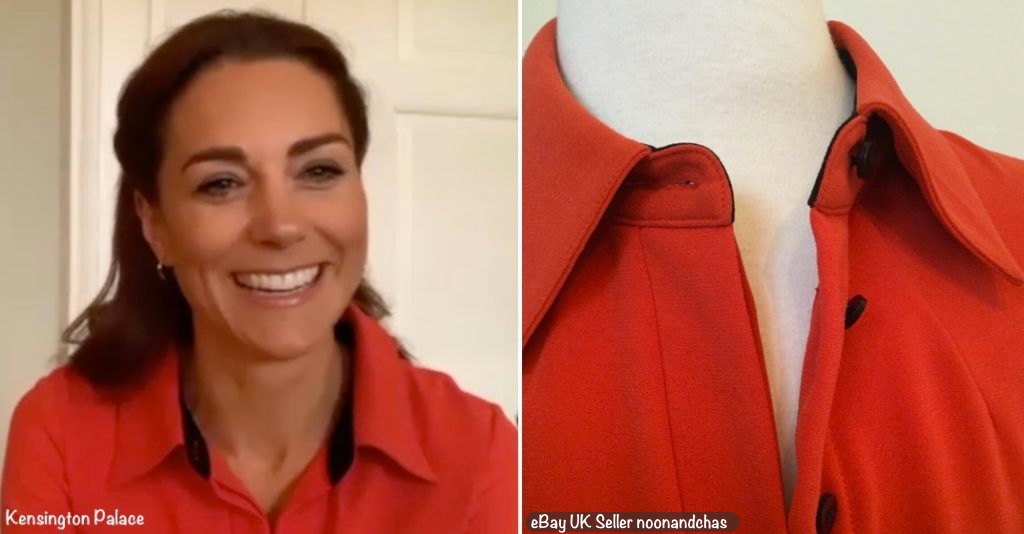
The Loreley has a hidden front placket with contrast buttons, contrasting trim on the inner collar, a yoked back, front bodice pockets, a self-belt, and elbow-length sleeves with contrasting buttons. Here is a closer look at the distinctive collar trim with another photo from the noonandchas dress listing on eBay.     

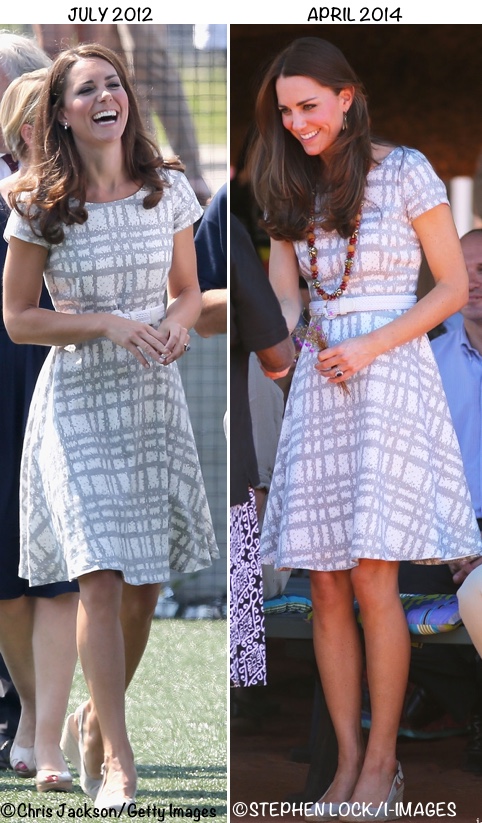
Stephanie and I have been chatting and wondering if perhaps Kate purchased this the same time she bought the Hobbs Wessex dress from the same season’s collection, first worn in July 2012, and then brought back during the 2014 Australia tour.

One quick FYI: Hobbs is in the midst of its summer sale, and there are quite a few bargains available, with some items discounted 70%.  Another Kate favorite, LK Bennett, is also having its summer sale, and they have items marked down as much as 60%. 


Pin It

Source link
[ad_2]
source https://earn8online.com/index.php/81659/a-look-at-some-of-kates-one-hit-wonders-and-ufo-dress-identified/